Bike Lane or Sidewalk? The Simple Rule That Can Save You a Fine (and a Fight)
Cyclists on the sidewalk, e-scooters in bike lanes, pedestrians startled at the curb: one sign or marking can change everything. Here’s how to read it in seconds.
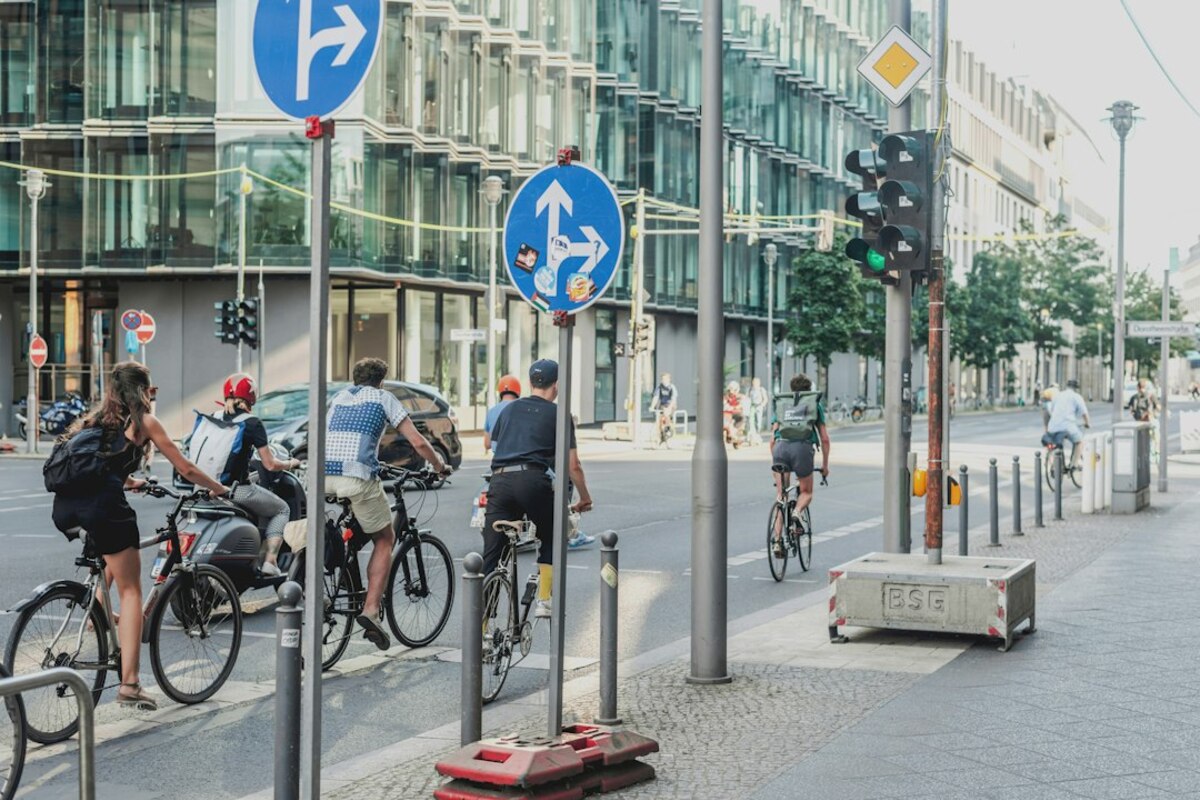
- In Germany, cycling on the sidewalk is usually not allowed—unless a sign explicitly permits it or the rider is a child.
- E-scooters belong on bike lanes or the road, not on sidewalks—many everyday ‘quick shortcuts’ can trigger fines.
- Road markings and small blue signs decide where you’re allowed to ride; misunderstandings often lead to accidents and liability disputes.
The everyday situation: one street, three “lanes”, five different assumptions
You’re walking home after work. The sidewalk is busy, people carry shopping bags, someone pushes a stroller. Next to it there’s a narrow strip with a bicycle symbol painted on the ground. A cyclist rings a bell behind you, another one rides on the sidewalk anyway, and an e-scooter zips past like it’s late for a meeting.
Almost everyone in that scene thinks they know the rules. And almost everyone is partly wrong—because in German traffic law, the details decide: a small blue sign, a thin dashed line, a different pavement color, or whether the “bike lane” is actually a bike lane at all.
This topic keeps coming up in cities and suburbs alike because everyday mobility is changing: more bicycles, more cargo bikes, more e-scooters, more delivery traffic, and tighter streets. That means more conflicts—and more tickets—based on a simple question: Where are you actually allowed to ride?

How to “read” the street in 10 seconds: sidewalk, bike lane, or just paint?
Let’s turn the confusion into a quick mental checklist you can apply while moving. Imagine the street as having three possible spaces: sidewalk (for walking), bike infrastructure (for cycling), and roadway (for vehicles). The law assigns vehicles to specific spaces, but what counts as “bike infrastructure” isn’t always obvious.
1) The sidewalk (Gehweg)
Sidewalks are primarily for pedestrians. For adults on bicycles, the sidewalk is normally a no-go. Why? Because bicycles are legally considered vehicles. When bicycles mix with pedestrians at speed, conflict is almost guaranteed: sudden turns, dogs on leashes, kids stepping sideways, people exiting buildings.
Typical real-life scenario: A cyclist uses the sidewalk “just for 100 meters” to avoid a busy intersection. A pedestrian steps out of a shop. They collide. Even if nobody wanted trouble, the legal discussion often starts with: “Why were you riding there in the first place?”
2) A real bike lane (Radweg / Radfahrstreifen)
Bike lanes can be:
- Physically separated paths (often next to the sidewalk, sometimes with different paving).
- Bike lanes on the road marked by a solid line (often with bike symbols).
The key difference is not “how it looks” but whether it’s officially designated and whether its use is mandatory or optional.
3) A “bike suggestion lane” (Schutzstreifen / painted guidance)
Many streets have painted bicycle markings that look like a bike lane but don’t function like one. A classic example is a dashed line on the road with bike symbols. Cars may cross it when necessary (for example to pass oncoming traffic safely), but must show special care. Cyclists still ride there as their space, but it’s not a physically protected lane.
Common misunderstanding: People see paint and think “cyclists must ride there.” That’s not always true. Some markings guide cyclists but do not create a strict obligation like a mandatory bike lane sign would.
| What you see | What it often is | Typical rule of thumb |
|---|---|---|
| Raised path next to sidewalk, sometimes red paving | Cycle path (Radweg) or shared path | Check for a blue sign: it decides whether it’s mandatory, shared, or not a cycle path at all |
| Solid white line on road, bike symbols | Bike lane on roadway (Radfahrstreifen) | Cars should not drive/park on it; cyclists generally use it |
| Dashed line on road, bike symbols | Protection lane (Schutzstreifen) | Cars may cross if needed but must be careful; cyclists can use it but watch for encroaching traffic |
| Sidewalk with a small “Cyclists allowed” sign | Sidewalk opened for cycling (Gehweg „Radfahrer frei“) | Cyclists may ride but must adapt to walking speed and give pedestrians priority |
The tiny sign that changes everything: In many places, what matters most is the blue circular sign (mandatory infrastructure) or the additional plate reading “Radfahrer frei” (cyclists permitted). No sign often means: don’t assume.
Cyclists, children, e-scooters: who may use the sidewalk—and when?
This is where the everyday debates usually start: “But I’ve seen people do it all the time.” Frequency isn’t permission. The rules depend on the vehicle type and, for children, on age.
Cycling on the sidewalk (adults)
As a basic principle: adults cycling on the sidewalk is generally not permitted unless the sidewalk is explicitly opened for cycling (for example, via a sign allowing cyclists). Even then, it’s not a racing track. Pedestrians keep priority.
Practical picture: Think of it like entering someone else’s living room. You may be invited in (sign allows it), but you’re still the guest: slow down, be predictable, and never pressure others with bells or close passes.
Children on bicycles
Children have special protections. Young kids are allowed (and at certain ages expected) to use the sidewalk because they are less able to handle fast traffic. In everyday life this often affects parents too: if a child is riding on the sidewalk, a supervising adult may be allowed to accompany the child under certain conditions. The idea is simple: a child shouldn’t be forced into fast-moving car traffic before they can realistically manage it.
Typical conflict: A parent rides next to their child on the sidewalk, a pedestrian complains: “Bikes don’t belong here.” The nuance is that for children, the law recognizes safety and supervision as a priority.
E-scooters (E-Tretroller)
E-scooters are not “toys” in legal terms; they are motorized vehicles with their own set of rules. In practice, this means: they generally belong on bike infrastructure or the roadway—not on sidewalks. Many of the most common fines in city traffic come from e-scooters being used on sidewalks or being parked in a way that blocks pedestrians.
Everyday example: Someone leaves an e-scooter diagonally across the sidewalk near a bus stop. A visually impaired person or someone with a stroller must step into the road to pass. That’s not just rude—it can become a safety issue and trigger enforcement.
Shared paths: “pedestrians and cyclists”
Some routes are explicitly designated as shared. These are often riverside promenades, park connectors, or older paths. In these spaces, nobody “wins” by insisting on maximum speed or maximum right-of-way. Legally and practically, the expectation is mutual care and reduced speed.
Not necessarily. Paint can guide behavior, but official permission is usually tied to signage and the formal designation of the path. When in doubt, look for a clear sign that opens the sidewalk for cycling or creates a shared path.
Not necessarily. Paint can guide behavior, but official permission is usually tied to signage and the formal designation of the path. When in doubt, look for a clear sign that opens the sidewalk for cycling or creates a shared path.
Feeling unsafe is understandable, but it doesn’t automatically create a legal right to use the sidewalk. The safer choice might be a parallel side street, a different route, or dismounting and walking the bicycle where needed.
Feeling unsafe is understandable, but it doesn’t automatically create a legal right to use the sidewalk. The safer choice might be a parallel side street, a different route, or dismounting and walking the bicycle where needed.
Pedestrians. Cycling may be permitted, but the expectation is that cyclists adapt—often meaning very slow speed, extra distance, and no pressure. If it’s crowded, walking the bike can be the most sensible option.
Pedestrians. Cycling may be permitted, but the expectation is that cyclists adapt—often meaning very slow speed, extra distance, and no pressure. If it’s crowded, walking the bike can be the most sensible option.
Why this matters in real life: fines, accidents, and the awkward question of liability
Most people don’t worry about the rules until something goes wrong: a near miss, a crash, a police stop, or a letter from an insurance company. Then the “small” question—bike lane or sidewalk—suddenly becomes central.
1) The fine you didn’t expect
Many traffic violations in this area happen without bad intentions. People take shortcuts, avoid busy roads, or follow what others do. But enforcement can be surprisingly strict in certain cities or during targeted police checks (for example near schools, shopping streets, or accident hotspots).
Typical ticket scenario: A commuter cycles on the sidewalk along a main road for a few blocks. A police patrol stops them and points out that cycling is not permitted there. The cyclist argues “but there’s no safe bike lane.” The officer replies: “Then you must use the road or dismount.”
2) The accident scenario: “You came from the wrong place”
In collisions, the direction and the permitted area can matter a lot. If someone rides where they shouldn’t, the other party (and their insurer) may argue that this contributed to the accident—even if the other party also made a mistake. This is particularly relevant at:
- driveways and parking exits (cars crossing sidewalks)
- turning intersections (especially right turns by cars)
- bus stops and delivery zones
Short scenario: A cyclist rides on the sidewalk past a line of parked cars. A car door opens. The cyclist crashes. Even if the dooring driver acted carelessly, the argument may arise that the cyclist shouldn’t have been riding on the sidewalk at speed in the first place. The real outcome depends on the exact facts, but the location question becomes part of the liability puzzle.
3) The social conflict: bells, blame, and “I have the right!”
Many conflicts never reach the police but still poison everyday life. A pedestrian feels threatened; a cyclist feels ignored; an e-scooter rider feels judged. Clear rules help reduce that friction.
A good mental model is this: rights in traffic come with “space responsibilities.” If you’re using the sidewalk (where permitted), you’re borrowing pedestrian space. If you’re driving a car near a bike lane, you’re operating the heaviest object in the scene. If you’re on a bicycle in a painted lane, you’re visible but vulnerable. Understanding which space you’re in helps you act accordingly.
Mini-checklist you can actually use tomorrow morning
- No sign? Don’t assume the sidewalk is for cycling. If you’re unsure, slow down and look again—or dismount briefly.
- Blue mandatory sign nearby? It likely indicates a designated path; pay attention to whether it’s for cyclists only or shared.
- “Radfahrer frei”? Cycling is allowed, but pedestrians have priority and speed should be close to walking pace in crowds.
- E-scooter? Think “bike lane or road,” not sidewalk.
- With children? Safety rules and age-related exceptions can apply; ride predictably and give extra room.
In day-to-day traffic, the most helpful skill isn’t memorizing paragraphs of law—it’s learning to “read” the street like a map: what is meant for walking, what is built for riding, and what is just paint that looks official. Once you do, many of the loudest conflicts simply don’t happen in the first place.